
BUILT TO PERFORM. PROVEN ON EVERY HOME.
Every Bentley Built home is independently evaluated for energy performance — before and after construction — by a third-party Registered Energy Advisor. You get a number. A real, verified number. Not a marketing claim.

Our approach
Sustainability isn’t an add-on. It’s how we design from the start.
We don’t build to a specific label or standard — we build to the best performance achievable within your design and budget. What that means in practice is a consistent set of decisions made at every layer of the building envelope, starting at the foundation and working outward. Each layer is considered on its own merits and in relation to the whole.
The result is a home that is tighter, more comfortable, and less expensive to operate — not because we checked a box, but because of how it was built.
The envelope
Layer by layer — from slab to ridge.
Foundation – Start below grade
A well-performing home starts before the framing begins. We insulate under the slab prior to pouring — controlling heat loss, managing humidity, and reducing the risk of condensation at the floor level. Our baseline is R16 under-slab insulation, but we regularly spec R26 depending on the home’s design and your performance goals. Foundation walls follow the same wall assembly approach as the home above grade.
- R16 baseline
- Up to R26
- Continuous air barrier
Wall Assembly — The Service Wall
Our starting point for wall assemblies is what we call the service wall — a high-performance envelope that eliminates the two biggest sources of energy loss in a typical code-built wall: thermal bridging and air penetration.
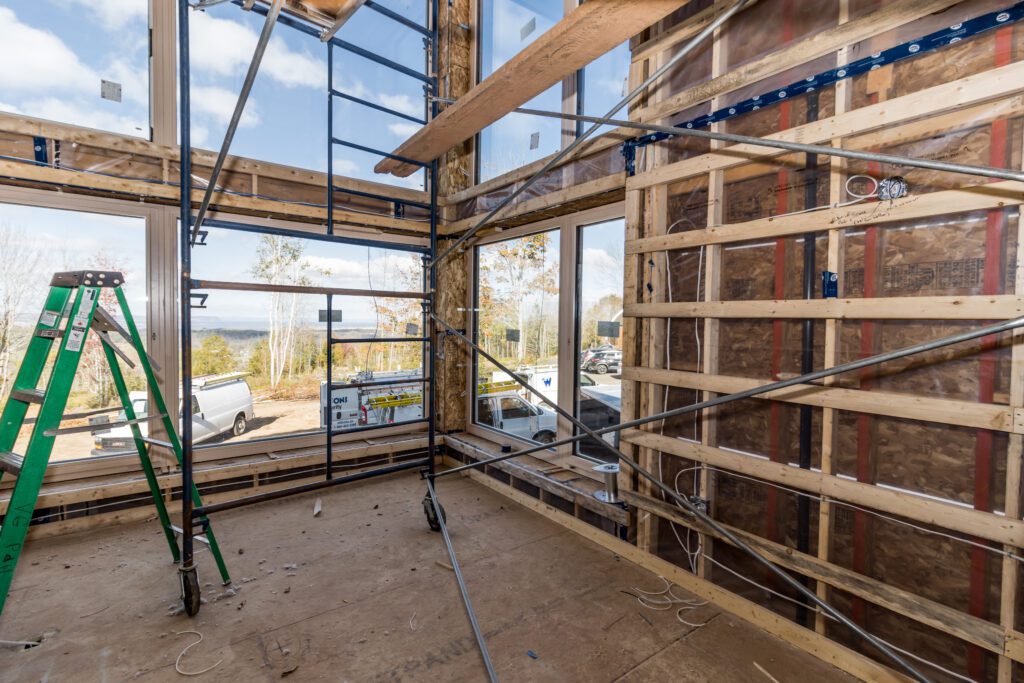
The assembly runs from the exterior stud wall inward: a 2×6 structural wall, a continuous layer of rigid foam, and then a 2×4 interior service wall. The service wall carries all your electrical, plumbing, and mechanical runs — keeping penetrations entirely out of the insulated plane. No holes through your thermal envelope.
The result is a R30 wall with no thermal bridging and a clean, continuous air barrier — something a standard code wall simply can’t achieve.
- R30 wall assembly
- No thermal bridging
- Continuous air barrier with limited, controlled penetrations
Wall Assembly — The Double Wall
Where performance goals call for it, we build a double wall — two stud walls separated by gap, and dense-packed from cavity to cavity with locally produced, sustainably sourced cellulose. The typical assembly runs 14 inches thick: an exterior 2×6, a 5-inch service gap, and an interior 2×4 wall, with horizontal strapping to hold back the cellulose and carry services. However, the wall thickness can shrink or scale depending on the project goals.
Cellulose is our preferred insulation for this assembly — and most of the home. It’s produced from recycled material, sourced locally, and performs exceptionally well when dense-packed: no settling, no voids, no thermal bridging, and no air movement through the wall plane.
The numbers speak for themselves.
- R40–R52 wall assembly
- No thermal bridging
- Continuous air barrier with limited, controlled penetrations
- Locally sourced, sustainably produced
Roof & Attic
Where heat wants to go
Heat rises — which means the attic is where an under-performing envelope gives itself away fastest. We design our roof assemblies to address this directly, starting with the truss itself.
We spec a 24-inch raised heel height on our trusses as standard. This is the detail that most builders skip — a standard heel height creates a choke point at the eave where insulation depth drops to almost nothing. A raised heel means full insulation depth from the exterior wall all the way across, with no compression at the edges.
We then install cellulose — the same locally sourced material we use in our walls. Our baseline is R60, and we regularly go to R80 or higher depending on the home. For vaulted ceiling applications where dense packing isn’t possible, we use high-performance fiberglass, specified and installed to achieve equivalent performance for that assembly.
- R60 baseline
- Up to R100
- 24″ raised heel
- Loose blown cellulose
Windows & Doors
The weakest link, treated seriously
Windows and doors are the lowest R-value component in any wall assembly — which means how they’re specified and installed matters as much as the glass itself. We select high-performance windows appropriate to the home’s design and budget, and we pay close attention to the installation detail: how they’re flashed, how they’re integrated into the air barrier, and how they perform at the rough opening where most of the heat loss actually happens.
Airtightness
The layer that ties everything together
Insulation value is only part of the story. A well-insulated wall with air leakage will still underperform — because moving air carries heat with it far more efficiently than conduction through a material ever could. Airtightness is the layer that makes everything else work. We design for airtightness from the start — detailing the air barrier continuously through every penetration, every intersection, and every transition between assemblies. And we verify it before the drywall goes on.
Pre-drywall blower door test
We perform our own blower door airtightness test on every project before drywall is installed. Once the walls are closed in, air leakage problems can’t be fixed — they can only be lived with. By testing while the building is still open, we can identify and address any issues while there’s still time to act. The final third-party evaluation by Efficiency Nova Scotia’s registered Energy Advisor confirms the result at completion.
The EnergyForward New Homes program
Independent verification
Every home evaluated. Every result third-party verified.
Every Bentley Built home is registered with Efficiency Nova Scotia’s EnergyForward New Homes program. A Registered Energy Advisor models the home before construction begins and conducts a final on-site evaluation — including a blower door airtightness test — once it’s complete.
The result is your home’s official Better Than Code (BTC) rating: a verified measure of how far above the minimum building code standard your home performs. The higher the number, the more energy efficient the home relative to a code-minimum build.
The program also provides incentives of up to $25,000 based on verified energy performance at completion. We register every eligible home on our clients’ behalf and return those funds to you in full.
-

Pre-Construction Modeling
Before construction begins, a Registered Energy Advisor models your home using your building plans and specifications. You receive a Design Evaluation — a projection of energy performance — along with recommendations for improving it within your design.
-
Construction
We build to the plan. Before drywall, we conduct our own blower door airtightness test to verify the building is performing to target — while there’s still time to address anything that isn’t.
-

Final on-site evaluation
Once the home is complete, Efficiency Nova Scotia’s Registered Energy Advisor conducts a final on-site evaluation — including an independent blower door test. This establishes the official BTC rating and issues your EnerGuide label.
-

Verified result — and your incentive
Your BTC rating is documented. Your EnerGuide label is issued. Your EnergyForward incentive is returned to you in full. The number in our portfolio below is that verified result.